Written by Monica Izu, founder of WeFixPay · Figures checked against HMRC, GOV.UK and NHS Employers · Last reviewed: 21 November 2026
UK tax year 2026/27 · 6 April 2026 to 5 April 2027 · Last reviewed 21 November 2026
Why is tax on my bonus so high? There is no special UK bonus or overtime Income Tax rate. Bonuses and overtime are normally taxable employment earnings, added to your other pay. The extra money may sit in a higher Income Tax band, trigger employee National Insurance for that pay period, increase student loan deductions and sometimes count towards pension contributions. A single bonus-month payslip can therefore look very different from your normal payslip.
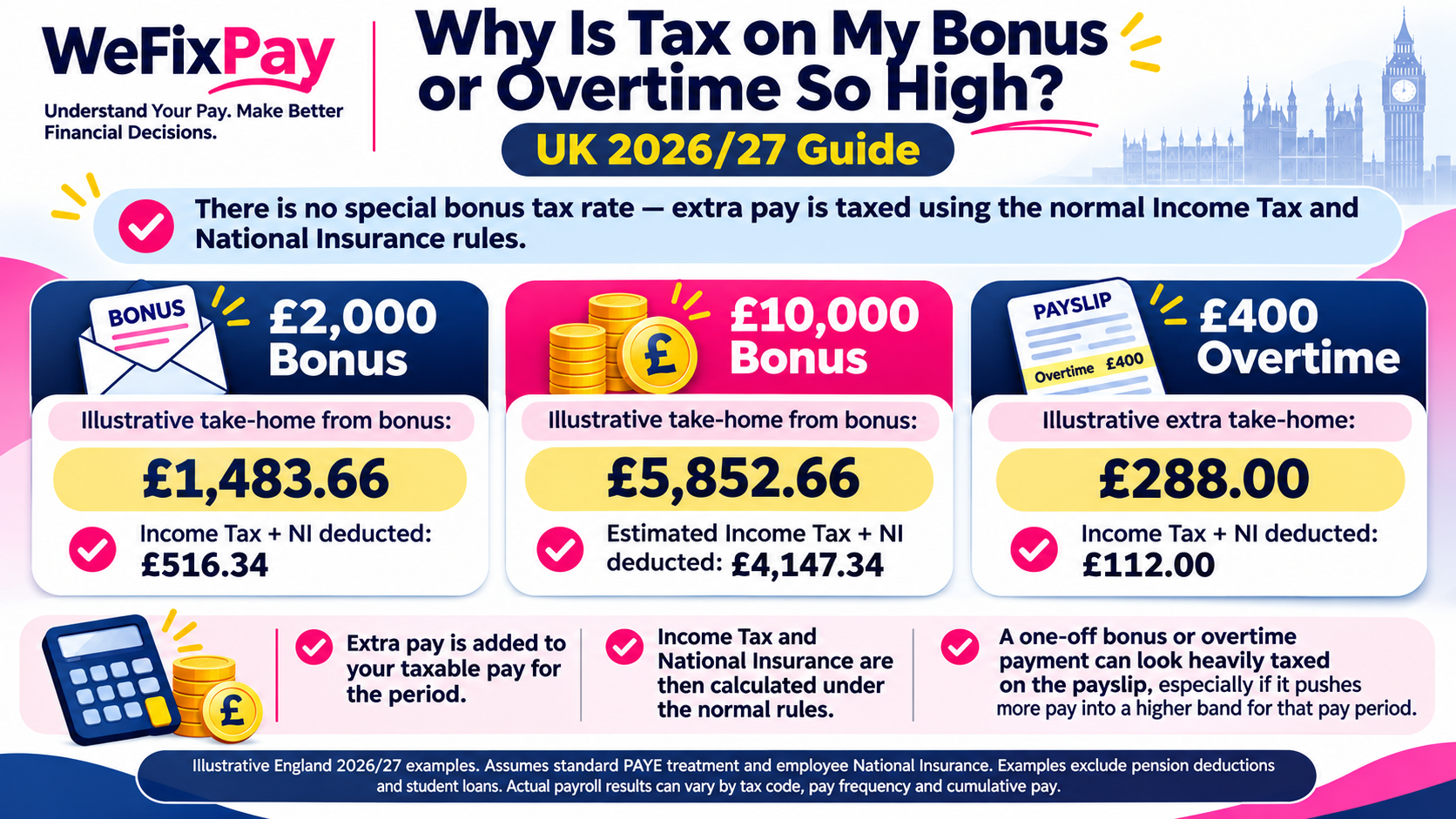
Quick answer: In an illustrative England example, someone earning £35,000 a year who receives a £2,000 bonus keeps about £1,483.66 of that bonus after additional annualised Income Tax and monthly employee NI, before any pension or student loan. With a Plan 2 loan, the illustrative extra student loan deduction is £180, leaving about £1,303.66. Actual PAYE in the bonus month can be different and may be adjusted later.
This guide shows how the deductions work, including a £2,000 bonus, a £10,000 bonus that crosses the higher-rate threshold, and £400 overtime. It also explains what to check if your payslip seems wrong.
Is bonus pay taxed differently from salary?
No. For most employees, a bonus or overtime payment is treated as ordinary taxable pay under PAYE. Income Tax is progressive: rates apply to the slices of taxable income in each band, not one rate to your entire salary. For England, Wales and Northern Ireland, the usual 2026/27 Personal Allowance is £12,570, basic-rate tax is 20% on the next £37,700, the higher rate is 40% above £50,270 of total income (with the standard allowance), and an additional 45% rate applies above £125,140. The Personal Allowance begins to taper above £100,000. Scotland has different bands and rates on employment income; see below.
Four reasons extra pay can look heavily taxed
1. The bonus may land in a higher Income Tax band
A bonus is added to other earnings. If your ordinary salary already uses most of your basic-rate band, the next pound of taxable pay may be taxed at 40%, even though your previous payslip looked like a 20% tax month. Only the portion entering a higher band attracts that rate. PAYE may initially withhold a different amount because it uses the tax code and pay-to-date position, not a simple fixed percentage on the bonus.
2. National Insurance is usually calculated each pay period
For most employees with NI category A, the 2026/27 standard monthly primary threshold is £1,048 and upper earnings limit is £4,189. Employee NI is generally 8% between those thresholds and 2% above the upper limit. A bonus can push a month across the upper limit, so its marginal NI rate may be partly 8% and partly 2%. This usually is not recalculated by averaging the whole year; directors and certain special cases differ.
3. Student loan deductions can increase
Student loan repayments are usually based on gross earnings before tax, including bonuses and overtime, when pay exceeds the relevant pay-period threshold. The usual rate is 9% on eligible undergraduate plans and 6% on a separate Postgraduate Loan. An employee repaying both may have both deductions. Actual payroll deductions are rounded down to whole pounds. See our Student Loan Plans Explained guide.
4. Other payroll deductions can apply
A workplace pension may use pensionable pay that includes or excludes overtime or bonuses. Salary sacrifice may change taxable and NI-able pay. Employee benefit deductions, attachment of earnings orders and unusual pay adjustments also affect the amount arriving in your bank. Compare the difference between a normal payslip and your bonus payslip, rather than adding the tax line alone.
Worked example 1: £2,000 bonus on a £35,000 salary
Assumptions: Employee living in England; £35,000 regular annual salary, paid monthly, 2026/27 rates, standard Personal Allowance, NI category A, no pension, no benefits, no other taxable income. A one-off £2,000 bonus arrives in one month. The Income Tax calculation below is an annualised comparison of income at £35,000 and £37,000; it is not a prediction of the exact PAYE line on the bonus-month payslip.
| Incremental deductions from the £2,000 bonus | Amount |
|---|---|
| Extra Income Tax: 20% × £2,000 | £400.00 |
| Extra employee NI for the bonus month | £116.34 |
| Extra take-home after tax and NI | £1,483.66 |
| Extra Plan 2 student loan deduction, if applicable | £180.00 |
| Extra take-home after tax, NI and Plan 2 | £1,303.66 |
How the extra National Insurance was calculated
Normal gross monthly salary is approximately £2,916.67; bonus-month gross pay is £4,916.67. Of the £2,000 bonus, £1,272.33 falls between normal pay and the £4,189 NI upper earnings limit, at 8% (£101.79). The remaining £727.67 falls above £4,189 at 2% (£14.55). Extra NI ≈ £116.34. Payslip rounding can differ by a penny.
Normal month versus bonus month — how to compare them
| Payslip comparison | Normal month | Bonus month |
|---|---|---|
| Gross pay | £2,916.67 | £4,916.67 |
| Employee NI (illustrative) | £149.49 | £265.83 |
| Increase in NI | — | £116.34 |
| Plan 2 loan deduction, if applicable | £42 | £222 |
| Increase in Plan 2 deduction | — | £180 |
Important: The table deliberately does not show PAYE tax for the two actual months: that amount depends on which tax month contains the bonus, the employee's cumulative tax-to-date, and any W1/M1 code. The annualised additional Income Tax remains £400 under these assumptions.
Worked example 2: £10,000 bonus on a £50,000 salary
Assumptions: England; ordinary taxable salary £50,000; one £10,000 bonus in a single month, producing £60,000 annual taxable earnings; normal monthly pay £4,166.67, rising to £14,166.67 in the bonus month; standard allowances and NI category A; no pension, student loans or other adjustments.
| Deduction attributable to £10,000 bonus | Amount |
|---|---|
| Annualised extra Income Tax | £3,946.00 |
| Additional employee NI in bonus month | £201.34 |
| Extra take-home after tax and NI | £5,852.66 |
The normal £50,000 salary leaves £270 in the basic-rate band (up to total income of £50,270). So £270 × 20% = £54, and £9,730 × 40% = £3,892. Extra annual Income Tax = £3,946. The NI increase is about £201.34, because nearly all the bonus is over the monthly upper earnings limit and attracts 2% employee NI. A bonus of this size may have a very different PAYE withholding on the actual pay date; this is an annualised illustration.
Worked example 3: £400 of overtime on a £35,000 salary
Suppose the same England employee earns another £400 in one month and all that overtime remains within the 8% employee NI band. Assume the entire £400 also falls in the basic-rate Income Tax band.
| Incremental deduction | Amount |
|---|---|
| Extra Income Tax at 20% (annualised) | £80.00 |
| Extra employee NI at 8% | £32.00 |
| Extra take-home before a student loan | £288.00 |
| Extra Plan 2 deduction, if applicable | £36.00 |
| Extra take-home including Plan 2 | £252.00 |
The £400 overtime is still worth earning financially under these assumptions; the employee keeps a positive amount after deductions. Pension contributions, benefits and real-time PAYE timing can alter the figure. For your own hours and enhancements, try the WeFixPay Overtime Calculator.
Why a bonus early in the tax year can look unusually heavily taxed
Cumulative PAYE calculates tax by looking at taxable earnings, allowances and tax bands built up from the beginning of the tax year. Payroll compares tax due to date with tax already deducted, then deducts or refunds the difference. An unusually large payment in an early month can therefore temporarily put some pay into a higher slice of the year-to-date bands—even if your eventual full-year earnings will not reach that rate. As further months pass, cumulative PAYE can correct excess deductions within the same tax year.
With a Week 1 / Month 1 (W1/M1) tax code, each period is broadly assessed independently instead. The usual cumulative catch-up does not work the same way until a suitable cumulative code is issued. Read our UK Tax Codes Explained guide and check your personal tax account if your code looks wrong. A higher deduction is not by itself evidence of a payroll mistake.
What changes for employees in Scotland?
Scottish Income Tax is different. If you are a Scottish taxpayer, employment income (including bonuses and overtime) uses Scottish Income Tax bands, and your PAYE code will usually begin with S. The marginal Income Tax rate on extra earnings can therefore differ materially from the England examples above, particularly where pay enters Scottish higher-rate bands. Standard employee NI percentages and thresholds remain UK-wide for most employees. Our England examples must not be read as Scottish payslip predictions. Use the WeFixPay UK Tax Calculator with Scotland selected and consult GOV.UK's Scottish Income Tax guidance.
Why the £100,000 to £125,140 range can be especially costly
For someone entitled to the standard Personal Allowance, it reduces by £1 for every £2 of adjusted net income above £100,000 and reaches zero at £125,140. In England, Wales and Northern Ireland, an extra £1 in this range can therefore face an effective 60% Income Tax marginal rate before National Insurance; for a standard employee above the NI upper earnings limit, adding 2% NI gives approximately 62%, before student loans or other deductions. Scottish Income Tax can produce a different outcome. Pension contributions and Gift Aid can affect adjusted net income, but the treatment depends on the facts. Consider regulated financial or tax advice for complex cases.
Bonus or overtime taxed too much? A six-step payslip check
- Write down the gross extra pay. Identify the bonus, overtime, enhancements or commission separately from your standard wages.
- Compare two payslips. Note the change in PAYE, employee NI, pension and student loan deductions, not simply the bonus-month totals.
- Check your tax code and country. Look for 1257L, S-prefixed codes for Scotland, or W1/M1 emergency indicators where relevant.
- Check student loan plan(s). A bonus can increase repayments for a month even if your normal salary is below the plan threshold.
- Check pay-to-date and pay period. Cumulative PAYE, separate-period NI and whole-pound student loan rounding can cause different numbers.
- Use supporting tools. Compare estimates using our UK Tax Calculator, National Insurance Calculator and Overtime Calculator. You can also read How to Read a UK Payslip or investigate Why Your Take-Home Pay Is Lower Than Expected.
If you are unsure whether a deduction is correct, ask your payroll team for the pay-period and cumulative PAYE calculation; HMRC can help with tax-code questions. Do not assume a high deduction is an error without checking the pay basis.
What these examples do not include
- Pension contributions where bonuses or overtime are pensionable; salary sacrifice arrangements.
- Scottish Income Tax or unusual Welsh PAYE coding circumstances.
- Director NI annual calculations, reduced-rate NI categories or nonstandard pay frequencies.
- Student loan arrangements other than the explicitly illustrated Plan 2 examples.
- Taxable benefits, two jobs, benefit clawbacks, attachment orders or adjusted Personal Allowances.
Frequently asked questions
Is there a special 40% tax rate on UK bonuses?
No. The bonus is taxable employment pay. Only the slice of income inside the 40% band (where that band applies) is taxed at 40%; other slices use their respective rates.
Is overtime taxed more than normal wages?
There is no separate overtime Income Tax rate. Extra earnings can enter a higher tax band and can change deductions in a single pay period.
Will I get bonus tax back later?
Sometimes, depending on your tax code and full-year income. Cumulative PAYE may adjust within the same tax year. If it does not, check your tax record with HMRC. Monthly employee NI is generally not retrospectively averaged merely because later pay falls.
Does my bonus increase student loan repayments?
It can. If gross pay in that pay period exceeds the relevant threshold, payroll applies the plan's rate to eligible pay above the threshold, subject to rounding and combined-plan rules.
Does a £2,000 bonus mean £2,000 more take-home pay?
No. Income Tax, NI and possibly pension and student loan contributions reduce what reaches your bank. Under this guide's particular England assumptions, the annualised after-tax-and-NI addition is about £1,483.66, but the actual bonus-month PAYE amount may differ.
Could I receive a bonus in a different month?
Only if your employer's remuneration rules permit it. Timing can change pay-period NI and PAYE cash flow, but final annual Income Tax normally depends on the tax year's total taxable income and allowances.
Official sources and further reading
- GOV.UK — Rates and thresholds for employers 2026/27
- GOV.UK — Income Tax rates and allowances
- GOV.UK — National Insurance: How much you pay
- HMRC — PAYE cumulative and W1/M1 code use
- GOV.UK — Student and Postgraduate Loan deduction tables 2026/27
- GOV.UK — Scottish Income Tax rates
Last reviewed: 21 November 2026. Educational illustrations only, not tax or financial advice. WeFixPay estimates are not a substitute for your employer's payroll or HMRC records.