Written by Monica Izu, founder of WeFixPay · Figures checked against HMRC, GOV.UK and NHS Employers · Last reviewed: 8 November 2026
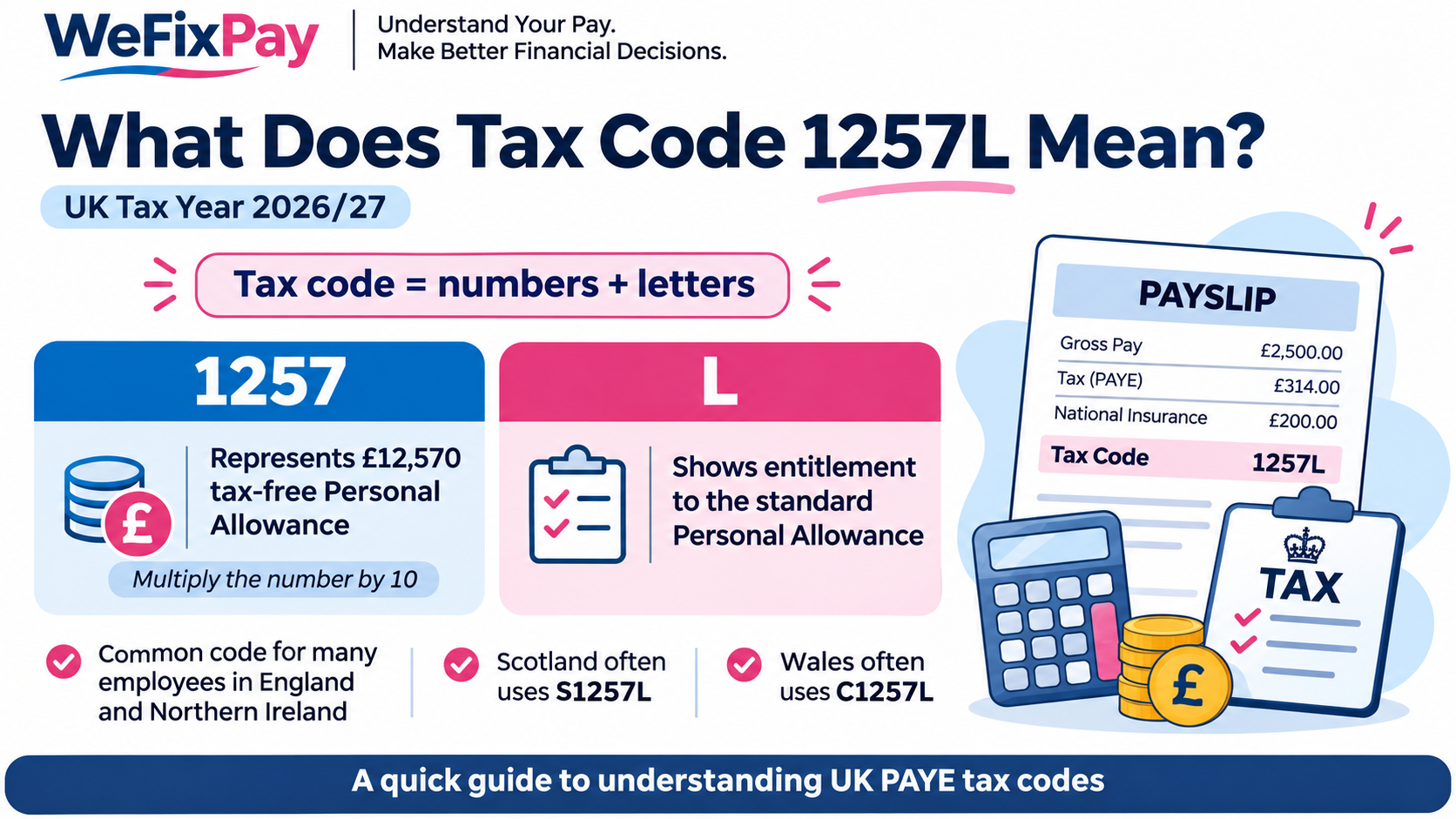
How to read tax code 1257L
1257 represents a tax-free amount of around £12,570 (multiply the number by ten). L indicates entitlement to the standard Personal Allowance. HMRC can adjust the number to account for untaxed benefits, earlier underpayments or other circumstances. For example, a code of 1100L generally indicates approximately £11,000 of tax-free pay allocated through that employment rather than £12,570. A tax code is a payroll instruction, not a complete statement of your final annual tax liability.UK tax code decoder: what do the letters mean?
↔ On a phone, swipe the table left or right if needed.
| Code | What it generally means | When you might see it |
|---|---|---|
| L | Standard Personal Allowance | A typical main job |
| M | Marriage Allowance received from a partner | Eligible receiving spouse or civil partner |
| N | Marriage Allowance transferred to a partner | Eligible transferring spouse or civil partner |
| T | Other calculations are involved in the allowance | HMRC needs to account for particular circumstances |
| 0T | No Personal Allowance in this job | Allowance used up or insufficient starter details |
| BR | All pay from this job taxed at basic rate | Often a second job or pension |
| D0 / D1 | All pay at higher / additional rate (England, Wales and NI) | Some second jobs or pensions |
| NT | No Income Tax deducted from this income | Specific HMRC circumstances |
| K | Adjustments exceed the Personal Allowance; extra amount added for tax calculations | Untaxed benefits, pension income or earlier tax owed |
Scottish and Welsh prefixes
An S prefix means Scottish Income Tax rates apply; a C prefix means Welsh rates apply. For example, S1257L and C1257L use the standard allowance with their respective regional rates. Scottish flat-rate codes include SBR (basic), SD0 (intermediate), SD1 (higher), SD2 (advanced) and SD3 (top). They are not interchangeable with D0 and D1.How different tax codes affect a £30,000 salary
Assumptions: 2026/27 Income Tax rates for England; one employment paying £30,000 evenly across the full tax year; no other taxable income, benefits, pension adjustments or student loan effects. Figures show Income Tax only, not National Insurance or net pay. They illustrate the annual effect of applying each code for a full year; actual PAYE can differ.↔ On a phone, swipe the table left or right if needed.
| Tax code | Allowance | Estimated annual Income Tax | Difference from 1257L |
|---|---|---|---|
| 1257L | £12,570 | £3,486 | — |
| 1100L | £11,000 | £3,800 | £314 more |
| 1383M* | £13,830 | £3,234 | £252 less |
| 0T | £0 | £6,000 | £2,514 more |
| BR | £0 in this job | £6,000 | £2,514 more |
Example: what does 0T mean on £30,000?
With 1257L: (£30,000 − £12,570) × 20% = £3,486 Income Tax. With 0T: £30,000 × 20% = £6,000. The difference is £2,514 a year, approximately £209.50 per month if spread evenly. That does not automatically mean HMRC owes you a refund: it depends on your overall tax position and why the code was used.Example: how a K code works
HMRC’s K475 example adds £4,750 to earnings for tax purposes. If the salary is £27,000, taxable pay for this simplified illustration becomes £31,750. At 20%, the illustrative tax is £6,350. Compare that with £2,886 for £27,000 under a standard 1257L code. A K code has an important protection: the Income Tax deducted in any pay period cannot exceed 50% of the employee’s pre-tax pay or pension.Emergency tax codes: W1, M1, X and NONCUM
Codes such as 1257L W1, 1257L M1 or 1257L X generally mean tax is calculated on a non-cumulative basis: the employer considers the current week or month rather than total pay and tax since 6 April. Your payslip might instead say NONCUM. This can lead to too much or too little tax being withheld. If you’ve changed jobs, providing your P45 can help your employer and HMRC use the correct details. Check your HMRC record if the code remains unexpected.What do M and N mean for Marriage Allowance?
M means you have received a Marriage Allowance transfer; N means you have transferred part of your Personal Allowance to your spouse or civil partner. For 2026/27, the transferable amount is normally £1,260. For a realistic illustration, suppose one eligible partner earns £10,000 and transfers £1,260 of their allowance, while the receiving partner earns £30,000 and is a basic-rate taxpayer. The recipient can potentially save £252 in annual Income Tax (20% of £1,260), subject to eligibility and individual circumstances. The transferring partner is still below their reduced allowance in this example.How to check and correct a tax code
- Find the code on your payslip. Look for “Tax code” or “PAYE code”.
- Use HMRC’s official checker. Visit Check what your tax code means.
- Check your circumstances. Have you started a new job, taken a second job, received taxable benefits or changed pension income?
- Review your HMRC online account. Update incorrect employment, income or benefit details, or contact HMRC.
- Compare deductions. Use our UK Tax Calculator and Salary Calculator for standard-assumption estimates, and our Payslip Checker to review payslip lines.