Written by Monica Izu, founder of WeFixPay · Figures checked against HMRC, GOV.UK and NHS Employers · Last reviewed: 19 November 2026
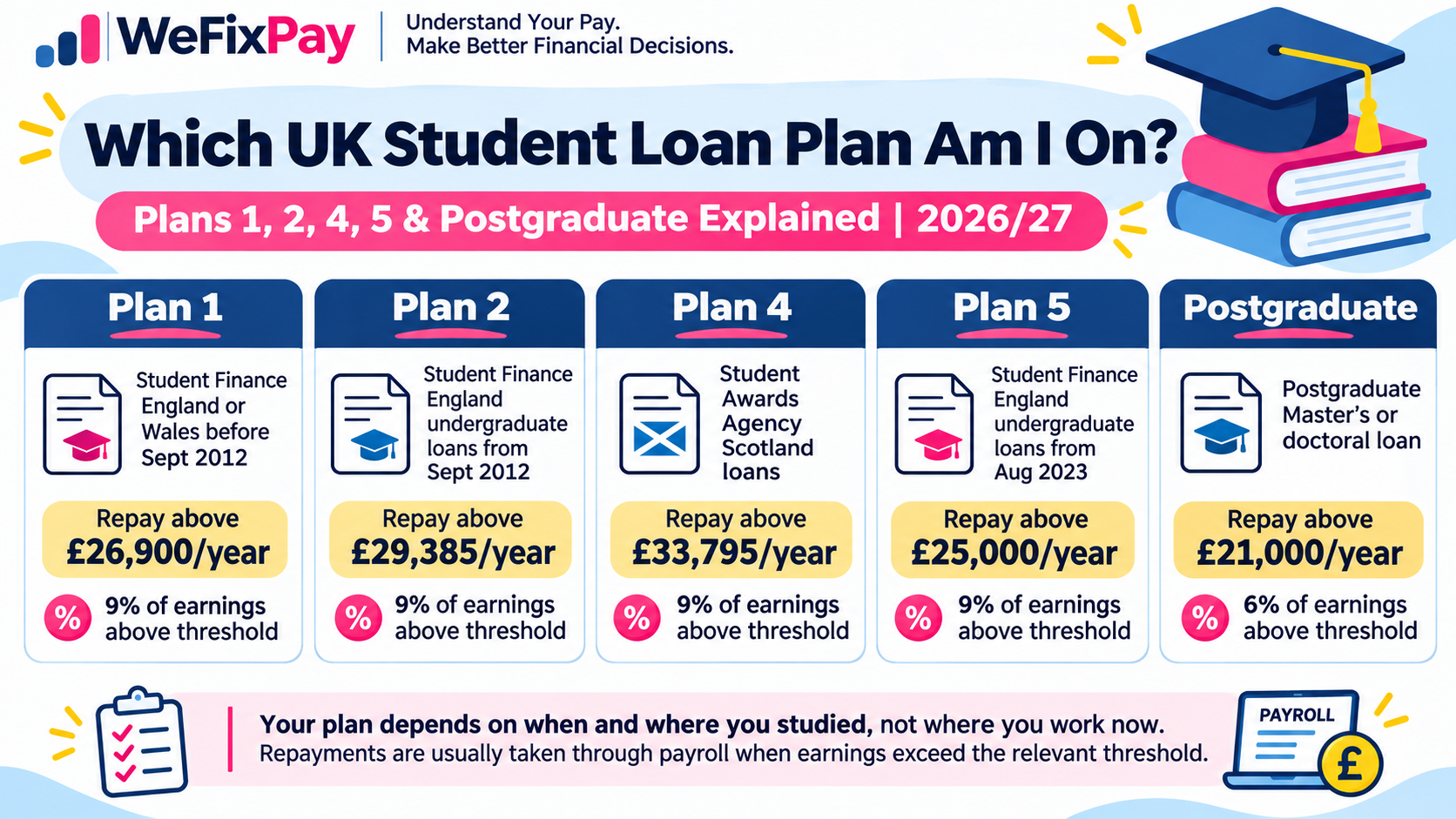
UK tax year 2026/27 · 6 April 2026 to 5 April 2027
Student loan plans explained: if you are wondering whether you are on Plan 1, Plan 2, Plan 4, Plan 5 or a Postgraduate Loan, the answer usually depends on which student finance organisation funded you, when you started and what you studied. Your plan determines the repayment threshold, not the amount of debt you have.
Most undergraduate plan repayments are 9% of earnings above the relevant threshold. The separate Postgraduate Loan repayment rate is 6%. This guide helps you find your plan, estimate deductions, understand combined loans and check your payslip.
Which student loan repayment plan am I on?
Start with the organisation you applied to for student finance. The country where you now work is not necessarily the country that determines your loan plan.
| Plan | Typical borrowers | 2026/27 annual threshold | Rate |
|---|---|---|---|
| Plan 1 | Student Finance England or Wales courses started before September 2012; Student Finance Northern Ireland borrowers, including postgraduate borrowers. | £26,900 | 9% |
| Plan 2 | Student Finance England undergraduate courses started from September 2012 to July 2023; Student Finance Wales undergraduate courses started from September 2012 onwards. Some loan types have additional exceptions. | £29,385 | 9% |
| Plan 4 | Student Awards Agency Scotland (SAAS) undergraduate and postgraduate borrowers. | £33,795 | 9% |
| Plan 5 | Student Finance England undergraduate courses started on or after 1 August 2023, plus certain other eligible loan types. | £25,000 | 9% |
| Postgraduate Loan | Eligible master's or doctoral loans from Student Finance England or Student Finance Wales. | £21,000 | 6% |
On a phone, swipe sideways across the table. Special cases apply to some course and loan types; your Student Loans Company record is definitive.
Not sure? Sign into your student loan repayment account and download your active plan type letter. If your employer has a different plan on payroll, ask them to correct it.
Student loan thresholds and how repayments are calculated
Plan 1, 2, 4 and 5 generally deduct 9% above the applicable pay-period threshold.
A separate Postgraduate Loan generally deducts 6% above its own threshold, even alongside an undergraduate plan.
For an annual estimate, use (annual repayment earnings − annual threshold) × repayment percentage, or zero if your earnings are below the threshold. PAYE actually uses your weekly or monthly pay period, and the final deduction is rounded down to a whole pound. Overtime and bonuses can therefore change individual months.
| Plan | Annual | Monthly PAYE threshold | Weekly PAYE threshold |
|---|---|---|---|
| Plan 1 | £26,900 | £2,241.66 | £517.30 |
| Plan 2 | £29,385 | £2,448.75 | £565.09 |
| Plan 4 | £33,795 | £2,816.25 | £649.90 |
| Plan 5 | £25,000 | £2,083.33 | £480.76 |
| Postgraduate | £21,000 | £1,750.00 | £403.84 |
These pay-period figures come from HMRC's 2026/27 payroll deduction tables. Earnings subject to student loan deductions generally follow the earnings measure used for employer Class 1 National Insurance.
What each plan repays at £25,000, £30,000, £40,000 and £55,000
The following figures are annualised mathematical estimates for a single loan, before pay-period rounding. They assume a consistent annual income and do not include tax, National Insurance or pensions.
| Annual salary | Plan 1 | Plan 2 | Plan 4 | Plan 5 | Postgrad |
|---|---|---|---|---|---|
| £25,000 | £0 | £0 | £0 | £0 | £240 |
| £30,000 | £279 | £55.35 | £0 | £450 | £540 |
| £40,000 | £1,179 | £955.35 | £558.45 | £1,350 | £1,140 |
| £55,000 | £2,529 | £2,305.35 | £1,908.45 | £2,700 | £2,040 |
At £30,000, Plan 5 produces a £450 annualised repayment while Plan 2 produces £55.35. That difference comes from their different thresholds, not from the balance borrowed.
Worked example: Plan 2 plus a Postgraduate Loan at £40,000
Imagine an employee with £40,000 annual gross pay who has both Plan 2 and an England or Wales Postgraduate Loan.
Annualised comparison
Postgraduate: (£40,000 − £21,000) × 6% = £1,140 annually.
Total annualised estimate: £2,095.35 (approximately £174.61 per month before payroll rounding).
What may actually appear on a monthly payslip?
If that employee is paid exactly £3,333.33 gross in a particular month, the payroll calculation is different:
| Monthly payslip line | Calculation | Deduction |
|---|---|---|
| Student Loan Plan 2 | (£3,333.33 − £2,448.75) × 9% = £79.61; round down | £79 |
| Postgraduate Loan | (£3,333.33 − £1,750) × 6% = £94.9998; round down | £94 |
| Total student loan deductions | Two deductions, rounded separately | £173 |
Important: If a different month shows £3,333.34, the Postgraduate Loan deduction may be £95 instead. Monthly payslip totals can vary slightly with the actual gross pay, frequency and rounding. Do not expect the annual calculation divided by 12 to match each payslip exactly.
What if you have two or more student loan plans?
- Two undergraduate plans: PAYE normally deducts 9% above the lowest relevant threshold, as one student loan deduction. Student Loans Company allocates that repayment between loans under its rules; you do not simply pay 9% for each undergraduate loan separately.
- Undergraduate plan plus Postgraduate Loan: Both rates can apply, producing a 9% undergraduate deduction and an additional 6% postgraduate deduction.
- Two separate jobs: PAYE normally calculates deductions separately for each employer's pay, rather than combining both salaries for one monthly threshold.
- Self Assessment: HMRC generally uses annual income from the return and takes account of PAYE deductions already made.
Why did a bonus trigger a student loan deduction?
Payroll tests each pay period against your plan threshold. A one-off bonus, overtime payment or extra shifts can push a particular month above the threshold, even if your typical salary is below it. If your annual income ends up below the relevant threshold, you may be able to request a refund of repayments made through PAYE. Eligibility depends on your circumstances and plan.
For a clearer view of your deductions, use the WeFixPay Student Loan Calculator. For the other payslip lines, see How to Read a UK Payslip or the Payslip Checker.
When is each student loan written off?
| Plan | Normal write-off rule |
|---|---|
| Plan 1 | First loan paid on/after 1 September 2006: 25 years after the April you were first due to repay. Earlier loans: age 65. |
| Plan 2 | 30 years after the April you were first due to repay. |
| Plan 4 | First loan paid on/after 1 August 2007: 30 years after the April you were first due to repay. Earlier loans: age 65 or 30 years, whichever is sooner. |
| Plan 5 | 40 years after the April you were first due to repay. |
| Postgraduate Loan | England and Wales: 30 years after the April you were first due to repay. |
Your actual date depends on your loan history. The Student Loans Company also cancels loans following a borrower's death and may cancel them in specified circumstances involving disability benefits, subject to its evidence requirements.
Plan 2 threshold freeze: what changes in 2027/28?
The Education (Student Loans) (Repayment) (Amendment) (No. 2) Regulations 2026 set the Plan 2 annual repayment threshold at £29,385 for 2027/28, 2028/29 and 2029/30. In other words, the Plan 2 threshold will not increase during those three tax years under the current regulations. A frozen threshold can mean borrowers repay more than they otherwise would as wages rise.
Confirmed 2027/28 figures for selected plans
| Plan | 2026/27 threshold | 2027/28 threshold |
|---|---|---|
| Plan 2 | £29,385 | £29,385 |
| Plan 5 | £25,000 | £26,025 |
| Postgraduate | £21,000 | £21,000 |
These 2027/28 figures were confirmed by the Student Loans Company on 12 November 2026. Check current official guidance before using any future-year amount; this article's calculations use 2026/27 only.
Checklist: check your student loan deduction
- Confirm your plan: Download the active plan type letter from your student loan account.
- Check the payroll plan: Ask HR/payroll which plan it has recorded.
- Check the pay period: Monthly and weekly thresholds are different.
- Check the earnings used: Include relevant bonus and overtime earnings, and consider salary sacrifice where applicable.
- Allow for rounding: PAYE deductions are rounded down to a whole pound for each relevant loan.
- Investigate unexpected deductions: Ask payroll to check the plan and any start or stop notice; contact SLC about your account.
Frequently asked questions
How do I find out which student loan plan I am on?
Check your Student Loans Company online account and download your active plan type letter. Match it against the plan used by your employer.
Does the amount I owe affect my monthly repayment?
Normally no. Income and plan thresholds determine the scheduled repayment, unless you are reaching the end of the balance or have alternative arrangements.
Can I repay Plan 2 and a Postgraduate Loan together?
Yes. The 9% and 6% calculations can both apply to relevant earnings in the same pay period.
Can I get a refund if a bonus triggered deductions?
Possibly. If your total annual income is below the annual threshold for your plan, check the refund conditions with the Student Loans Company.
Does student loan repayment start immediately after graduation?
Usually no. Repayments generally begin no earlier than the April after you leave or finish your course, subject to special timing rules such as certain part-time courses, and only if your earnings exceed the threshold.
Will my student loan eventually be written off?
Most income-contingent student loans have a write-off point. The timeframe depends on your plan and when you first received the loan.
Useful WeFixPay tools and guides
- Student Loan Calculator — estimate repayments for a chosen plan or combination.
- Salary Calculator — compare take-home pay assumptions.
- How to Read a UK Payslip — understand where student loan deductions appear.
- Why Take-Home Pay Is Lower Than Expected — explore other payroll differences.
- Payslip Checker — review figures shown on a payslip.
Official sources
- GOV.UK: Which repayment plan you are on
- GOV.UK: How much you repay
- HMRC: 2026/27 payroll deduction tables
- GOV.UK: Write-off and cancellation rules
- Legislation: Plan 2 threshold freeze regulations 2026
- Student Loans Company: 2027/28 thresholds announcement, 12 November 2026
Last reviewed: 19 November 2026. Educational estimates, not individual tax, debt or financial advice. For your personal loan plan and balance, consult your Student Loans Company account.