Written by Monica Izu, founder of WeFixPay · Figures checked against HMRC, GOV.UK and NHS Employers · Last reviewed: 14 November 2026
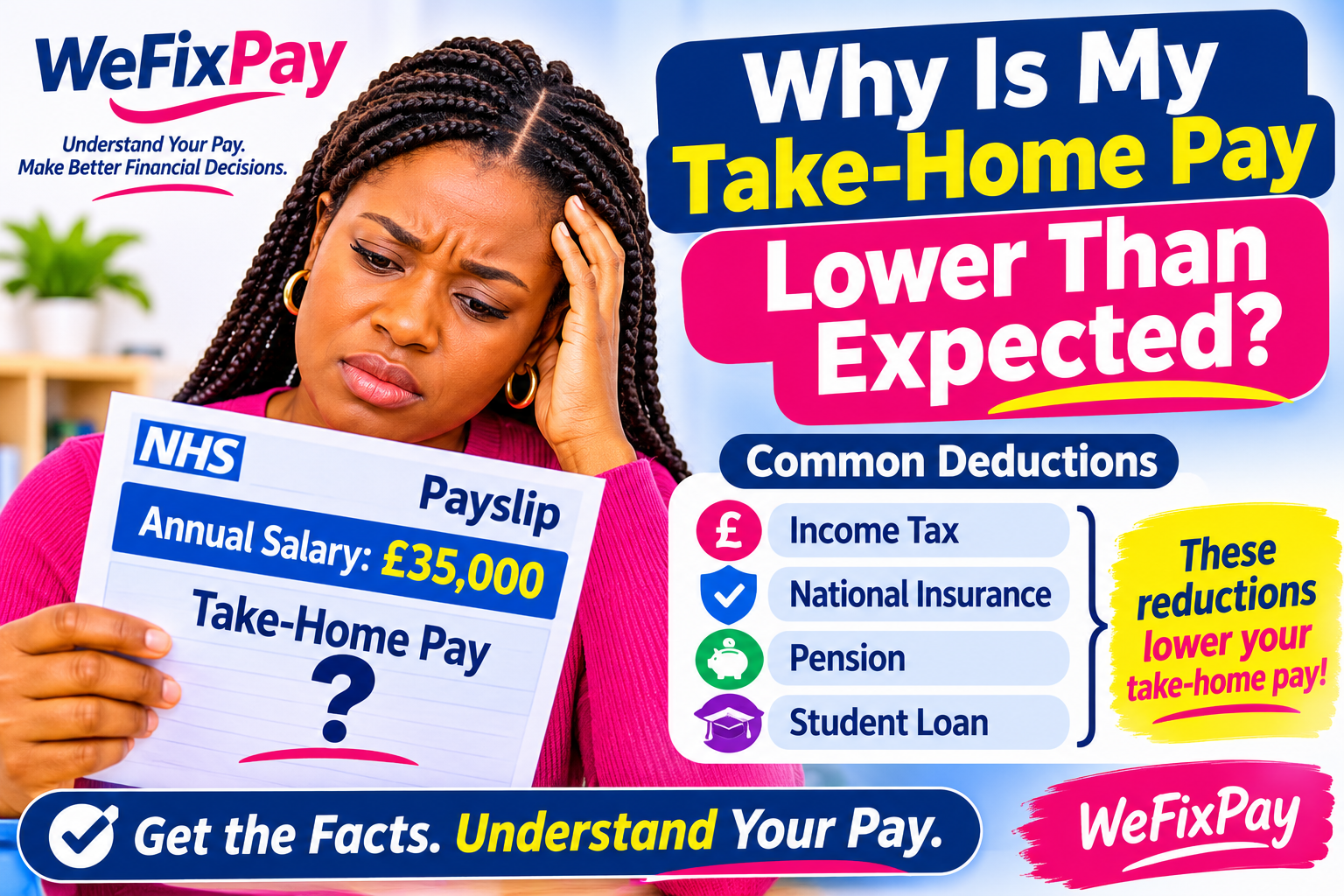
Is your take-home pay lower than expected? A salary calculator provides an estimate, but your actual payslip may include deductions or payroll adjustments that change the amount you receive.
UK tax year 2026/27 (6 April 2026 to 5 April 2027)
If your payslip shows less than a salary calculator predicted, the reason is often that the calculator and payroll are using different assumptions. An estimate may omit a student loan, use a different pension setting, assume the standard tax code or spread annual earnings evenly across 12 months. Your employer calculates deductions using your actual pay, tax code and pay period.
This guide explains eight common causes, walks through a £35,000 example, and shows you how to find the difference without guessing. A discrepancy is worth checking: a payslip records deductions made, but those deductions are not necessarily correct.
A worked example: why £35,000 does not pay what you expect
Assumptions: Employee in England, paid monthly; £35,000 fixed annual gross salary; standard 1257L tax code; 2026/27 rates; employee National Insurance category A; no benefits, overtime or other deductions. The basic comparison assumes no pension and no student loan. The example payslip adds a 5% employee pension contribution on qualifying earnings under a net pay arrangement, plus a Plan 2 student loan. These are illustrative figures, not a reproduction of an employer's payslip.
First, a basic estimate with just Income Tax and employee NI is approximately £2,393.35 a month (£2,916.67 gross pay minus £373.83 estimated PAYE and £149.49 estimated NI). This is not the same as the default result of every calculator; check which deductions are enabled.
Now include the pension and student loan:
| Illustrative monthly payslip line | Amount |
|---|---|
| Gross pay | £2,916.67 |
| Employee pension — 5% of qualifying earnings | −£119.83 |
| Income Tax after net pay pension deduction | −£349.87 |
| Employee National Insurance | −£149.49 |
| Student loan — Plan 2 (payroll-rounded) | −£42.00 |
| Estimated take-home pay | £2,255.48 |
The difference is about £137.87 a month compared with the tax-and-NI-only estimate. Here's why:
- Pension: about £95.87 net effect. The £119.83 pension deduction reduces taxable pay, so Income Tax is about £23.96 lower than in the no-pension example. This applies to the net pay pension method used here; other pension methods differ.
- Student loan: £42.00 in this illustrative monthly payroll calculation. Using the monthly Plan 2 threshold of £2,448.75, the unrounded amount is about £42.11; payroll normally rounds the deduction down to the nearest whole pound.
Important: Your actual payslip can differ by a few pence because PAYE and NI use pay-period methods and rounding. A pension using relief at source or salary sacrifice would also change the example. This table is for learning how the gap arises, not checking an exact payroll liability.
The 8 most common causes
1. A workplace pension
Your payslip may include pension contributions that your calculator has not included. In a common minimum-contribution arrangement, 8% of qualifying earnings goes towards the pension in total, with at least 3% from the employer; the remaining 5% employee-side amount can include tax relief, depending on the scheme. The 2026/27 annual qualifying-earnings band is £6,240 to £50,270. Your own pension scheme may use other pensionable earnings or higher rates.
Your take-home pay also depends on whether your workplace uses net pay, relief at source or salary sacrifice. The WeFixPay Pension Calculator estimates employee and employer contributions; it does not by itself establish your final payslip deduction or tax-relief method.
2. A student loan or Postgraduate Loan
Repayments depend on earnings above the threshold for your plan, not your original loan balance. The official 2026/27 thresholds are:
| Loan plan | Annual threshold | Repayment rate |
|---|---|---|
| Plan 1 | £26,900 | 9% |
| Plan 2 | £29,385 | 9% |
| Plan 4 | £33,795 | 9% |
| Plan 5 | £25,000 | 9% |
| Postgraduate Loan | £21,000 | 6% |
If you have a student loan and a Postgraduate Loan, both deductions can apply. Student loan deductions are calculated from relevant pay-period earnings and normally rounded down to whole pounds. The Student Loan Calculator gives annualised estimates, which may not match an individual payslip exactly.
3. A different tax code
A calculator may assume 1257L in England or Northern Ireland, while your employer uses another code. For example, 1100L broadly allocates £11,000 rather than £12,570 of tax-free pay to that job. For someone whose entire difference falls in the 20% band, that could mean approximately £314 more tax per year, or £26.17 per month. Actual PAYE depends on the employee's circumstances and cumulative tax treatment.
Read our published UK Tax Codes Explained 2026/27 guide for 1257L, BR, 0T, K codes and how to check them.
4. Taxable benefits in kind
A company car, private medical insurance or other taxable benefit may increase the Income Tax deducted from your wages, even though you are not paid cash for the benefit. HMRC may adjust your tax code, or your employer may process the benefit through payroll.
Example: A benefit worth £2,000 for tax purposes could create £400 additional annual Income Tax for someone wholly in the 20% band. This is not automatically a £2,000 cash deduction from their payslip.
5. A second job or pension income
Your tax-free Personal Allowance may be allocated mainly to one employment. Another employer might use BR, which generally taxes income from that job at the basic rate without an allowance. However, BR does not necessarily describe your final overall tax liability. Compare both tax codes and HMRC's records rather than assuming the second employer has made a mistake.
6. Salary sacrifice and other scheme deductions
You may have agreed to deductions or changes to gross pay for Cycle to Work, workplace savings, union subscriptions, charitable giving or other arrangements. Salary sacrifice changes the contractual cash salary used for some tax calculations; ordinary after-tax deductions do not work the same way. Check the exact label and whether the amount is taken before or after tax.
7. Pay period and timing
A four-weekly payroll makes 13 payments per year, whereas monthly payroll makes 12. Dividing annual salary by 12 will therefore overstate an individual four-weekly gross payment. Overtime and bonuses may also be processed after a payroll cut-off, and unpaid leave or a mid-month start can reduce pay for a specific period. Compare the correct dates and hours, not just the annual salary figure.
8. An emergency tax code
Codes ending W1, M1 or X use a non-cumulative calculation for the current pay period. They can cause too much or too little Income Tax to be deducted compared with a cumulative calculation, particularly after changing jobs or receiving irregular pay. If you think the code is wrong, use HMRC's tax-code service or speak to your employer's payroll team.
How to find your own gap in six steps
- Re-create the estimate. Use the WeFixPay Salary Calculator with the correct tax region and the same gross salary. Choose its no-pension option for a tax-and-NI-only baseline, or the illustrated 5% workplace pension (net pay) option if that is closer to your scheme. The calculator is an estimate, not an exact model of every pension or student loan arrangement.
- Read the whole payslip. Note the gross pay, taxable pay, NI-able pay, tax code, pay frequency and every deduction. Separate employer pension contributions from deductions taken from your pay.
- Reconcile the difference. Compare each line with the deductions included in the estimate. Don't simply add all extra deductions: a net pay pension can also lower Income Tax, and salary sacrifice may affect NI.
- Check your tax code. Use the published tax-code guide and compare the code shown on your payslip with your HMRC account.
- Check timing and rounding. Confirm whether the payslip covers a month, four weeks or a partial period; review bonuses, overtime, unpaid leave and student-loan payroll rounding.
- Investigate an unexplained gap. The WeFixPay Payslip Checker may help you organise and review deductions. If there is still a discrepancy, ask payroll for a written breakdown and contact HMRC about tax-code issues.
Frequently asked questions
Why is my payslip lower than my salary divided by 12?
Annual salary divided by 12 gives gross monthly pay, not what reaches your bank account. Income Tax, employee NI, pension contributions, student loans and other deductions can lower the amount received. A four-weekly payslip also covers a different period.
How much tax and NI would I pay on £35,000 in England?
With a standard £12,570 Personal Allowance, no pension and standard category A NI, a simple annual illustration gives £4,486 Income Tax and £1,794.40 employee NI. Actual payslip deductions can vary with pay period, pension method and tax code.
Does a pension reduce my take-home pay?
Usually yes, but the effect depends on the pension arrangement. In our £35,000 example, an estimated £119.83 employee contribution under a net pay arrangement reduces take-home pay by about £95.87, because PAYE tax also falls. That is not the result for every pension arrangement.
Is the calculator or my payslip right?
The payslip shows what payroll actually deducted, while the calculator shows an estimate based on selected assumptions. Neither guarantees the deductions are correct. If something looks wrong, check the tax code, payroll inputs and deduction rules, then ask payroll or HMRC to investigate.
Why is my take-home pay different from last month?
Overtime, a bonus, changes to hours, a pay rise, unpaid leave, pension changes, a new tax code or the timing of payroll can change your monthly net pay. Student loan deductions can also rise during a higher-earning pay period.
Official sources and review information
- HMRC: Rates and thresholds for employers 2026 to 2027
- GOV.UK: How much you repay on a student loan
- The Pensions Regulator: Automatic enrolment earnings thresholds
- GOV.UK: Workplace pensions and how contributions work
- GOV.UK: Tax codes and emergency tax codes
Content reviewed: 9 November 2026.
Disclaimer: WeFixPay offers general educational estimates. Actual payroll deductions depend on individual circumstances, pay periods, tax codes and scheme rules. This guide is not personalised financial, tax or legal advice.