Written by Monica Izu, founder of WeFixPay · Figures checked against HMRC, GOV.UK and NHS Employers · Last reviewed: 17 November 2026
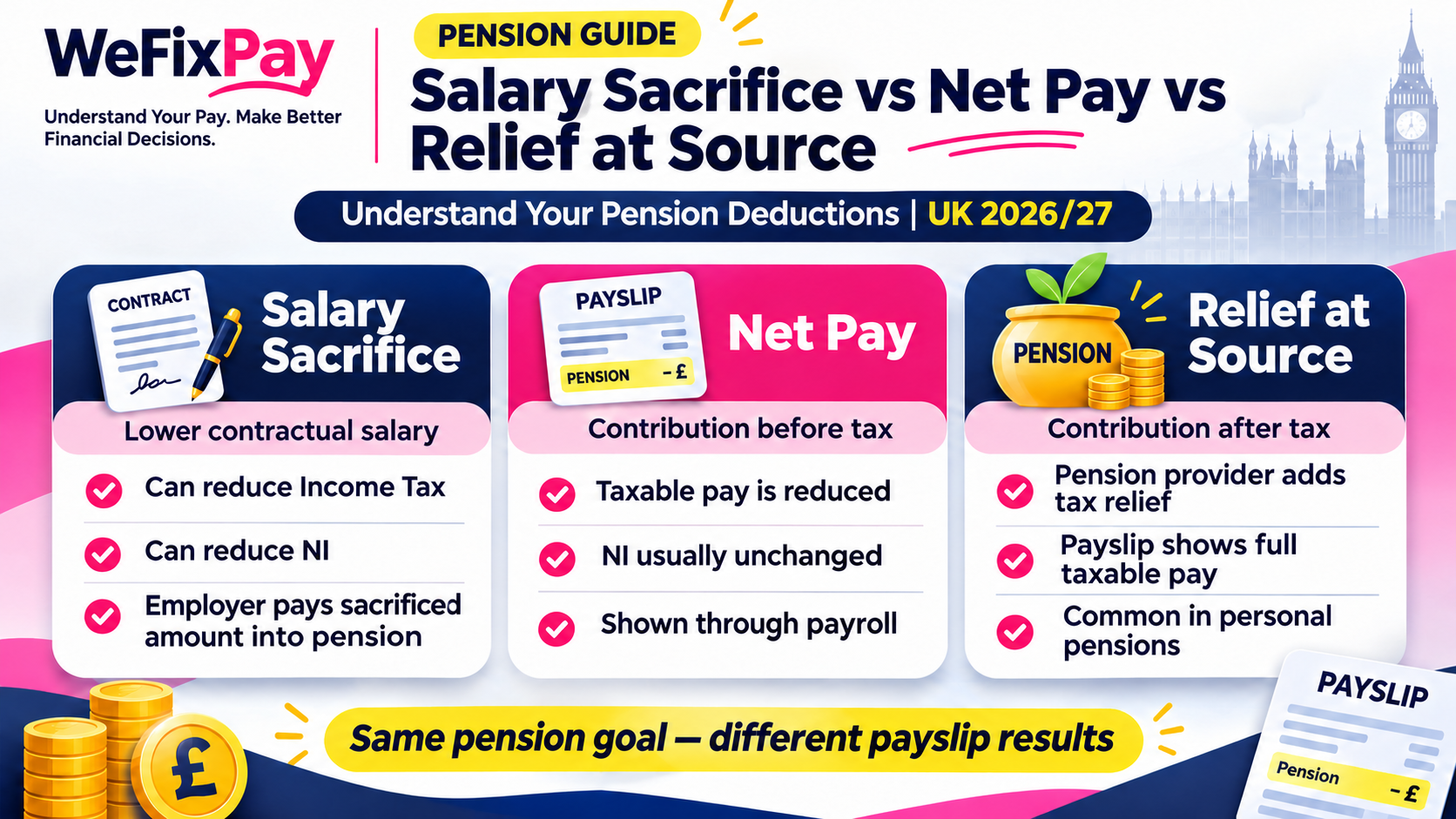
Salary sacrifice vs net pay vs relief at source: these three workplace pension methods affect how contributions appear on your payslip, how you receive Income Tax relief and whether you save National Insurance.
Three pension methods can produce three different-looking payslips — even when the same amount goes towards retirement. Net pay arrangements reduce your taxable pay; relief at source takes a smaller contribution from pay after tax and adds tax relief in your pension; salary sacrifice replaces part of your contractual salary with an employer pension contribution.
For an employee paying basic-rate Income Tax in England, net pay and relief at source can have the same eventual take-home cost when the gross pension contributions are equal. Under the 2026/27 rules, salary sacrifice can also reduce employee National Insurance, although eligibility and other consequences matter.
This guide compares all three methods, calculates the effect at four annual salaries, explains the legislated April 2029 reform, and shows how to identify the method on your payslip.
Quick answer: On a £30,000 salary, using a £1,188 gross annual pension amount, the simplified take-home pay is £24,169.20 under net pay or relief at source, compared with £24,264.24 under salary sacrifice — an NI saving of £95.04 a year. These figures assume England, 2026/27 rates, a standard Personal Allowance, no student loan and no other deductions.
The three pension contribution methods at a glance
| Question | Net pay arrangement | Relief at source | Salary sacrifice |
|---|---|---|---|
| What happens? | Employee pension contribution comes out before Income Tax | Employee pays from after-tax pay; scheme adds basic-rate tax relief | Employee gives up salary; employer pays that amount into the pension |
| Income Tax treatment | Taxable pay is reduced | Provider usually adds 20% to the net contribution; extra relief may need to be claimed | Lower contractual salary normally means lower taxable earnings |
| Employee National Insurance | Usually unchanged | Usually unchanged | Can be lower under 2026/27 rules |
| Example pension amount | £1,188 gross deducted | £950.40 deducted + £237.60 provider top-up = £1,188 gross | £1,188 salary given up; £1,188 employer pension contribution |
| Employment contract changes? | Normally no | Normally no | Yes, the salary-sacrifice agreement changes contractual cash pay |
| Higher-rate tax relief | Generally reflected through payroll | Additional relief may need to be claimed from HMRC | Reflected through lower taxable salary |
Do not confuse “net pay arrangement” with “net pay” on your payslip. A net pay arrangement is a particular method of pension tax relief; net pay on your payslip generally means what lands in your bank account.
The £30,000 worked example: why the figures differ
Assume a £30,000 yearly salary in England, standard 1257L allowance, employee NI category A, 12 broadly equal pay periods, no student loan, no other deductions, and a pension scheme using qualifying earnings (£6,240 to £50,270 in 2026/27).
The example targets a 5% gross employee-side pension amount on qualifying earnings, rather than suggesting that every workplace pension uses the same contribution basis:
(£30,000 − £6,240) × 5% = £1,188 a year, or £99 gross pension amount per month.
For many automatic-enrolment schemes, the overall minimum is 8%, including an employer contribution of at least 3% of qualifying earnings. Employers may use other qualifying bases or more generous contributions.
| Method | Approx. annual take-home pay | Approx. monthly equivalent | Difference from net pay method |
|---|---|---|---|
| No pension | £25,120.00 | £2,093.33 | +£950.80 |
| Net pay arrangement | £24,169.20 | £2,014.10 | Baseline |
| Relief at source | £24,169.20 | £2,014.10 | £0.00 |
| Salary sacrifice | £24,264.24 | £2,022.02 | +£95.04 annually |
Monthly figures are annual totals divided by 12 for comparison, not a guarantee of an identical payslip amount every month. Actual payroll rounds figures each period.
Net pay arrangement: the £1,188 comes out before tax
- Gross salary: £30,000.
- Employee pension contribution: £1,188 (taken before Income Tax).
- Income Tax: (£30,000 − £1,188 − £12,570) × 20% = £3,248.40.
- Employee National Insurance: (£30,000 − £12,570) × 8% = £1,394.40.
- Estimated take-home pay: £30,000 − £1,188 − £3,248.40 − £1,394.40 = £24,169.20.
Your payslip can show the full employee pension amount deducted, but the Income Tax calculation is based on the lower taxable pay.
Relief at source: £950.40 leaves the payslip, but £1,188 goes into the pension
The £1,188 is the gross pension contribution, not the amount taken from your take-home pay.
- Your contribution paid from after-tax wages: £950.40.
- Pension provider claims basic-rate tax relief: £237.60.
- Total credited as the gross employee contribution: £1,188.00.
- Income Tax on full salary: £3,486.00.
- Employee National Insurance on full salary: £1,394.40.
- Estimated take-home pay: £30,000 − £950.40 − £3,486.00 − £1,394.40 = £24,169.20.
Why the result matches net pay: You contribute £237.60 less from your wages, but your Income Tax is £237.60 higher. For this basic-rate taxpayer, the final cash result is the same.
Salary sacrifice: the extra saving comes from National Insurance
- Contractual salary after sacrifice: £30,000 − £1,188 = £28,812.
- Employer pays the sacrificed £1,188 into the pension, separately from any other employer contribution.
- Income Tax: (£28,812 − £12,570) × 20% = £3,248.40.
- Employee National Insurance: (£28,812 − £12,570) × 8% = £1,299.36.
- Estimated take-home pay: £28,812 − £3,248.40 − £1,299.36 = £24,264.24.
Compared with net pay, the employee NI saving is £1,394.40 − £1,299.36 = £95.04 per year, or roughly £7.92 per month.
How the comparison changes at £20,000, £45,000 and £60,000
These annualised figures use exactly the same assumptions as the £30,000 example and a 5% gross pension amount based on qualifying earnings.
| Annual salary | Gross pension amount | Net pay / RAS after any additional relief | Salary sacrifice | Extra take-home from sacrifice |
|---|---|---|---|---|
| £20,000 | £688.00 | £17,369.20 | £17,424.24 | £55.04 |
| £30,000 | £1,188.00 | £24,169.20 | £24,264.24 | £95.04 |
| £45,000 | £1,938.00 | £34,369.20 | £34,524.24 | £155.04 |
| £60,000 | £2,201.50 | £44,036.50 | £44,080.53 | £44.03 |
The £60,000 row needs an important qualification. Under relief at source, take-home pay on the payslip is approximately £43,596.20 before reclaiming the additional higher-rate relief of about £440.30. The table shows the effective result after that relief has been received. Its timing depends on how HMRC provides the adjustment. A net pay arrangement generally provides the higher-rate relief through payroll instead.
At £60,000, the sacrificed £2,201.50 falls above the 2026/27 employee NI upper earnings limit of £50,270, where the marginal employee NI rate is 2% rather than 8%. So the NI saving is about £44.03, not £176.
What salary sacrifice can affect besides take-home pay
Salary sacrifice is not automatically the best option for every employee. Before agreeing, ask payroll or HR about:
- Contractual versus reference salary. Does the employer preserve a notional or pre-sacrifice salary for pay rises, pensionable pay, life cover or other benefits?
- Statutory payments and benefits. Reduced cash earnings can affect some entitlement calculations, depending on the circumstances.
- Minimum wage rules. Salary sacrifice cannot reduce cash earnings below the applicable National Minimum Wage or National Living Wage.
- Mortgage or other borrowing applications. Ask whether the lender assesses your reference salary or reduced contractual salary.
- Employer National Insurance saving. Does your employer share any saving by paying more into your pension? This is not guaranteed.
- Student loan deductions. Salary sacrifice may also reduce the earnings used to calculate student loan repayments; that is not the same as cancelling the underlying debt.
In particular, the three methods cannot be chosen freely within every scheme. Check which arrangements your employer and pension provider actually offer.
What changes from 6 April 2029?
The National Insurance Contributions (Employer Pensions Contributions) Act 2026 provides for a new limit from 6 April 2029. Under the legislated reform, only the first £2,000 a year of pension contributions made through salary sacrifice benefit from the existing employee and employer National Insurance exemption. The sacrificed amount above £2,000 becomes subject to the relevant NI charges. Income Tax relief on pension contributions remains available under the normal rules. Ordinary employer-funded pension contributions are not generally caught in the same way. See the legislation and GOV.UK reform explanation.
For illustration, the assumed gross pension amounts at £30,000 (£1,188) and £45,000 (£1,938) are under the £2,000 annual limit. At £60,000, £2,201.50 would exceed it by £201.50. That does not mean the 2026/27 take-home-pay table should be recalculated using the future rules: the table describes 2026/27, before the reform takes effect.
NHS Pension Scheme: an important difference
If you're an NHS employee, do not apply the 5%-of-qualifying-earnings comparison directly to your NHS Pension Scheme deductions. The NHS Pension Scheme is a defined-benefit arrangement, with contribution rates based on pensionable pay and scheme rules, rather than this simple automatic-enrolment illustration. Member contributions are normally taken before Income Tax, and salary sacrifice for other benefits can affect pensionable pay in some circumstances.
Use your employer's NHS pension information and payslip for the exact figures. If you're unsure what was deducted, see our guide to reading a UK payslip and ask your payroll team.
How to tell which method your workplace uses
- Check your payslip. Compare taxable pay, gross/NI-able earnings and the pension deduction line. The label alone may not be conclusive.
- Check your pension statement. With relief at source, the pension provider normally adds its 20% top-up to what you paid; the top-up may not appear on the payslip.
- Check your contract. Salary sacrifice or salary exchange should be documented as a contractual arrangement.
- Ask payroll or the pension provider. Ask explicitly: “Is this a net pay arrangement, relief at source or salary sacrifice?”
For your own figures, try the WeFixPay Pension Calculator and Salary Calculator. If your payslip differs from an estimate, read why your take-home pay may be lower than expected, or check your deductions with the Payslip Checker.
What the example figures exclude
The comparisons do not account for Scottish Income Tax bands, Welsh-specific tax codes, student loans, extra pension contributions, salary-sacrifice employer top-ups, different contribution bases, NI category differences, pension annual allowance limits, adjusted Personal Allowances, or any specific NHS defined-benefit pension contribution rate. The figures are annualised illustrations, not individual payroll or financial advice.
Frequently asked questions
Is salary sacrifice always better than net pay?
Not necessarily. It can increase take-home pay through employee NI savings in 2026/27, but the contract, minimum wage rules, benefits, borrowing and employer policies matter. Check whether the employer passes any of its own NI savings into the pension.
Does relief at source reduce the pension contribution?
No. With the £30,000 example, £950.40 is deducted from pay and the provider adds £237.60. The gross employee pension contribution is £1,188.00.
Do I have to claim higher-rate relief?
If your scheme uses relief at source and you pay Income Tax above the basic rate, you may need to claim the additional relief from HMRC. This can be done through the appropriate HMRC process. In a net pay arrangement, higher-rate relief is generally reflected through payroll automatically.
What if I earn less than the Personal Allowance?
Relief at source can add basic-rate pension relief even when you do not pay Income Tax. Eligible low earners in net pay arrangements may instead receive an HMRC top-up under the relevant rules; the timing and administration differ.
Does the 2029 £2,000 cap apply already?
No. The worked examples in this guide use 2026/27 rules. The change is legislated to begin 6 April 2029.
Is the NHS Pension Scheme a salary-sacrifice pension?
No, ordinary membership of the NHS Pension Scheme should not be treated as the simplified salary-sacrifice example used here. It is a defined-benefit scheme with its own contribution rules.
Official sources
- GOV.UK — Salary sacrifice and PAYE
- Legislation.gov.uk — National Insurance Contributions (Employer Pensions Contributions) Act 2026
- GOV.UK — Salary sacrifice reform effective from 2029
- GOV.UK — 2026/27 PAYE and NI rates
- The Pensions Regulator — Minimum workplace pension contributions
- GOV.UK — How pension tax relief works
- NHSBSA — NHS Pension Scheme contribution tiers
WeFixPay provides general educational estimates, not personalised financial, legal or tax advice. Check your scheme documentation and payroll for individual results.