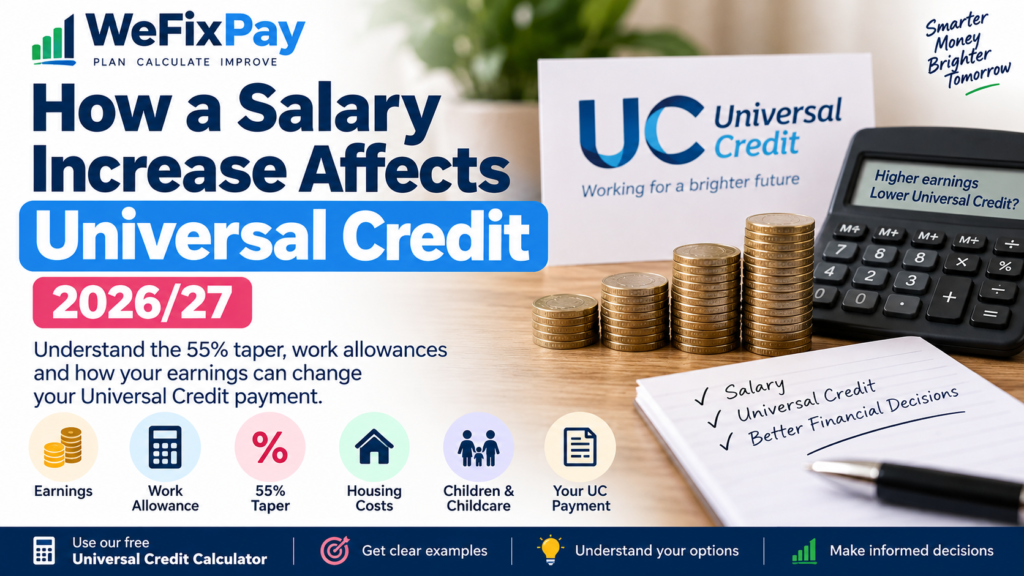
A salary increase affects Universal Credit because the payment is means-tested and adjusted according to your household earnings. If you or your partner are working, a higher salary can reduce the amount of Universal Credit you receive.
For every £1 of earnings, Universal Credit is generally reduced by 55p. Some households can earn a certain amount before the reduction starts. This is called a work allowance, and it can apply if you or your partner are responsible for a child or have a health condition that affects your ability to work.
For 2026/27, the work allowance is £427 per month where Universal Credit includes help with housing costs, or £710 per month where it does not. In this guide, we explain how salary increases, overtime, bonuses and different pay patterns can affect Universal Credit, with simple examples for UK workers.
Want to see how your own earnings could affect your payment? Try our free Universal Credit Calculator to estimate your earnings deduction and remaining monthly Universal Credit.
Universal Credit Rates for 2026/27
Universal Credit starts with a standard monthly allowance based on your age and whether you are single or claiming as a couple. Extra amounts may then be added for things such as children, housing costs, childcare, caring responsibilities or qualifying health-related circumstances.
For 2026/27, the standard monthly allowances are:
| Household | Monthly standard allowance |
|---|---|
| Single, under 25 | £338.58 |
| Single, aged 25 or over | £424.90 |
| Couple, both under 25 | £528.34 |
| Couple, one or both aged 25 or over | £666.97 |
These are the basic standard allowances. Your actual Universal Credit entitlement can be higher if additional elements apply, or lower because of earnings, other income, deductions or the benefit cap. The Department for Work and Pensions confirmed these 2026/27 rates in February 2026.
Work allowances for 2026/27
Some working households can earn a set amount before the Universal Credit earnings reduction begins. For 2026/27:
- £710 per month if your Universal Credit does not include a housing amount.
- £427 per month if your Universal Credit does include a housing amount.
A work allowance normally applies only where you or your partner are responsible for a child or have been assessed as having limited capability for work.
Once any applicable work allowance has been used, Universal Credit is normally reduced using the 55% taper rate. This means that for every additional £100 of earnings taken into account, Universal Credit generally falls by £55.
How the 55% Universal Credit Taper Works
Universal Credit does not usually stop immediately when you start earning more. Instead, your payment normally reduces gradually through the 55% taper rate.
For employed claimants, the taper is applied to earnings taken into account for Universal Credit, generally after Income Tax, employee National Insurance and eligible pension contributions. If you qualify for a work allowance, that allowance is deducted first and the 55% taper is applied only to the remaining earnings.
A simple formula is:
Universal Credit reduction = (earnings − applicable work allowance) × 55%
If you do not qualify for a work allowance, the 55% taper normally applies from the first £1 of earnings.
Then add this table:
| Monthly earnings used for UC | No work allowance | £427 work allowance | £710 work allowance |
|---|---|---|---|
| £500 | £275 reduction | £40.15 reduction | £0 reduction |
| £1,000 | £550 reduction | £315.15 reduction | £159.50 reduction |
| £1,500 | £825 reduction | £590.15 reduction | £434.50 reduction |
| £2,000 | £1,100 reduction | £865.15 reduction | £709.50 reduction |
Then paste:
For example, if your earnings taken into account for Universal Credit are £1,500 in a month and you qualify for the £427 housing-cost work allowance, £427 is ignored first. That leaves £1,073 subject to the taper:
£1,073 × 55% = £590.15
Your Universal Credit would therefore be reduced by approximately £590.15 for that assessment period, assuming your award is high enough for the full reduction to apply.
If the same household qualified for the £710 work allowance, only £790 would be subject to the taper:
£790 × 55% = £434.50
The examples above show only how earnings affect Universal Credit. Your actual payment also depends on your maximum Universal Credit award, housing costs, children, childcare, health or caring elements, other income, savings, deductions and the benefit cap where applicable. Universal Credit is calculated separately for each monthly assessment period, so changes in pay can change the amount you receive from one month to the next.
How a Salary Increase Affects Universal Credit
When your salary increases, your Universal Credit will usually fall gradually rather than stopping immediately. The amount it falls by depends on the earnings taken into account during your monthly Universal Credit assessment period and whether you qualify for a work allowance.
For example, imagine your earnings used for Universal Credit increase from £1,500 to £1,800 in one assessment period. That is an increase of £300.
If you are already above any applicable work allowance, the additional reduction in Universal Credit would normally be:
£300 × 55% = £165
So your Universal Credit would fall by approximately £165 for that assessment period.
This does not mean you lose 55p of Universal Credit for every £1 increase in your gross annual salary. Universal Credit normally uses earnings after deductions such as Income Tax, employee National Insurance and qualifying pension contributions, and a work allowance may also apply.
Example with the £427 work allowance
Suppose your earnings taken into account increase from £1,500 to £1,800 per month and you qualify for the £427 work allowance.
At £1,500:
£1,500 − £427 = £1,073
£1,073 × 55% = £590.15 reduction
At £1,800:
£1,800 − £427 = £1,373
£1,373 × 55% = £755.15 reduction
The salary increase therefore causes an additional Universal Credit reduction of:
£755.15 − £590.15 = £165
Does earning more still leave you better off?
In many cases, yes. The Universal Credit taper is designed so that your payment reduces gradually as earnings rise rather than removing £1 of Universal Credit for every £1 earned.
However, the overall effect on your household finances can also depend on Income Tax, National Insurance, pension contributions, childcare costs, housing costs and other benefits.
That is why it is useful to look at your total household income after deductions, rather than comparing salary and Universal Credit separately.
How Overtime and Bonuses Affect Universal Credit
Overtime, bonuses, extra shifts and other additional pay can affect Universal Credit because the amount you receive is recalculated for each monthly assessment period. If your earnings are higher in one assessment period, your Universal Credit will normally be lower for that period.
For example, suppose your normal earnings used for Universal Credit are £1,500 per month, but overtime increases them to £1,900. That is an additional £400 of earnings.
If you are already above any applicable work allowance:
£400 × 55% = £220
Your Universal Credit could therefore be around £220 lower for that assessment period because of the extra earnings.
The same principle generally applies to a bonus. If a bonus increases the earnings reported in one assessment period, Universal Credit can fall for that month. When earnings return to their normal level in a later assessment period, Universal Credit will usually adjust again.
What if you are paid more than once in one assessment period?
Your Universal Credit can also change if more than one wage payment falls inside the same monthly assessment period. This can happen particularly if you are paid weekly, every two weeks or every four weeks.
GOV.UK explains that receiving more wages than usual in one assessment period can mean you receive less Universal Credit for that month, or in some cases no Universal Credit payment at all if your earnings are high enough.
For monthly-paid workers, a payday that moves because of a weekend or bank holiday will usually be adjusted automatically by Universal Credit so that you receive your normal amount. If the calculation appears wrong, you can report it through your Universal Credit online account.
Does working extra hours always make you worse off?
No. Working extra hours increases your earnings, while Universal Credit normally reduces by 55p for every additional £1 of earnings taken into account above any applicable work allowance. Your overall household income will therefore often still increase, although Income Tax, National Insurance, pension contributions and other costs can affect how much extra money you actually keep.
Can a Pay Rise Stop Universal Credit Completely?
Yes. A pay rise can eventually reduce Universal Credit to £0, but there is no single salary level at which Universal Credit stops for everyone. The point at which your award ends depends on your household circumstances, including your maximum Universal Credit award, housing costs, children, childcare, health or caring elements, and whether a work allowance applies.
As earnings increase, Universal Credit is normally reduced using the 55% taper rate until the award reaches zero. If your wages later fall again, you may become entitled to Universal Credit once more. GOV.UK says that if it has been 6 months or less since your last Universal Credit payment, payments can normally restart automatically; after a longer gap, you may need to make a new claim.
Example
Suppose a household has a maximum Universal Credit award of £900 per month and does not qualify for a work allowance.
Because the taper is 55%, the earnings needed to reduce that £900 award to zero would be approximately:
£900 ÷ 55% = £1,636.36
So if around £1,636 of earnings were taken into account for Universal Credit in that assessment period, the £900 award could be fully tapered away.
If the same household qualified for the £427 work allowance, the rough point at which the award could reduce to zero would be:
£1,636.36 + £427 = £2,063.36
With the £710 work allowance, it would be approximately:
£1,636.36 + £710 = £2,346.36
These are simplified examples. The actual point at which Universal Credit stops can be different because the calculation is based on your own award and the earnings counted in that assessment period.
What happens if your earnings later fall?
If your wages decrease, Universal Credit can increase again. Your award is recalculated for each monthly assessment period, so people with variable earnings may move in and out of payment from month to month.
There are also surplus earnings rules in some cases. If your earnings are at least £2,500 above the level at which your Universal Credit would stop, some of the excess can be carried forward and counted in the next assessment period.
How Universal Credit Works for Couples When One Person Gets a Pay Rise
If you claim Universal Credit as a couple, your claim is assessed on your household circumstances and combined earnings, not just the income of one partner. A pay rise for either person can therefore reduce the Universal Credit paid to the household.
For every £1 you or your partner earns, Universal Credit is normally reduced by 55p once any applicable work allowance has been used. The work allowance applies to the household if either partner meets the qualifying conditions, such as being responsible for a child or having a health condition that affects the ability to work.
For 2026/27, the work allowance is:
- £427 per month if the household gets help with housing costs through Universal Credit.
- £710 per month if the household does not get help with housing costs through Universal Credit.
Example: one partner gets a £300 monthly pay rise
Suppose a couple’s combined earnings used for Universal Credit increase from £2,000 to £2,300 per month because one partner receives a pay rise.
If they are already above their work allowance, the additional Universal Credit reduction would normally be:
£300 × 55% = £165
So the household’s Universal Credit could fall by around £165 for that assessment period.
Example with the £427 work allowance
If the couple qualifies for the £427 work allowance:
At combined earnings of £2,000:
£2,000 − £427 = £1,573
£1,573 × 55% = £865.15 reduction
At combined earnings of £2,300:
£2,300 − £427 = £1,873
£1,873 × 55% = £1,030.15 reduction
The difference is again:
£1,030.15 − £865.15 = £165
A pay rise for either partner can therefore affect the joint Universal Credit payment even if the other partner’s earnings stay exactly the same.
Couples are responsible for keeping their joint Universal Credit claim up to date and reporting relevant changes in circumstances through their Universal Credit account.
How Savings Affect Universal Credit
Universal Credit is also affected by the amount of money, savings and investments you and your partner have. For 2026/27, the main capital limits remain £6,000 and £16,000.
If your household has:
- £6,000 or less in savings and capital, it normally does not reduce your Universal Credit.
- More than £6,000 but less than £16,000, your Universal Credit is reduced.
- £16,000 or more, you are usually not eligible for Universal Credit.
For savings between £6,000 and £16,000, Universal Credit assumes monthly income of £4.35 for every £250, or part of £250, above £6,000.
Example: £8,000 in savings
If you have £8,000, that is £2,000 above the £6,000 disregard.
£2,000 ÷ £250 = 8
8 × £4.35 = £34.80
So your Universal Credit would be reduced by approximately £34.80 per month because of your savings.
Example: £12,500 in savings
If you have £12,500, that is £6,500 above £6,000.
£6,500 ÷ £250 = 26
26 × £4.35 = £113.10
Your Universal Credit would therefore be reduced by approximately £113.10 per month.
If part of the amount above £6,000 is not a complete £250, Universal Credit still treats that remaining amount as another £250 for this calculation.
For couples, savings and investments are considered jointly. You must also report changes to your savings and investments through your Universal Credit account.
How Childcare Costs Affect Universal Credit
Universal Credit can help with childcare costs if you are working and use approved childcare. For 2026/27, Universal Credit can repay up to 85% of eligible childcare costs, subject to a monthly maximum.
The maximum childcare amount is:
- £1,071.09 per month for one child
- £1,836.16 per month for two or more children
If you live with a partner, you will usually both need to be in paid work, unless your partner cannot look after the children because of circumstances such as a qualifying health condition or caring responsibility. There is no minimum number of hours you must work.
Example: £800 monthly childcare bill
If your eligible childcare costs are £800 in a month:
£800 × 85% = £680
Universal Credit could therefore repay up to £680, assuming you meet the eligibility rules and the costs are accepted.
Example: £1,400 for one child
If you pay £1,400 for eligible childcare for one child:
£1,400 × 85% = £1,190
However, the monthly maximum for one child is £1,071.09, so the most Universal Credit could repay for that assessment period would be £1,071.09.
You normally pay childcare first
In most cases, you pay your childcare provider first and then report the cost through your Universal Credit account. Universal Credit then reimburses the eligible amount. You should report childcare costs as soon as you pay them, normally within the assessment period in which you paid them or the following assessment period.
If you are starting work or increasing your working hours and cannot afford the upfront childcare cost, you may be able to get additional help with that initial payment. GOV.UK says this support can include the first month’s childcare costs or additional costs caused by increased working hours.
Childcare support can therefore make a significant difference when comparing a pay rise or additional working hours with the extra cost of childcare.
How Housing Costs Affect Universal Credit
Universal Credit can include an extra amount to help with housing costs if you rent your home or, in some cases, have eligible service charges. The housing amount is added to your maximum Universal Credit award before earnings and other deductions are taken into account.
If you rent from a private landlord, the housing amount is usually based on the lower of:
- your actual eligible rent, or
- the relevant Local Housing Allowance (LHA) rate for your area and household size.
For 2026/27, LHA rates continue to vary significantly by area. For example, the monthly 2-bedroom LHA rate is £970 in Lothian, £850 in Greater Glasgow, and £625 in West Lothian.
This means that if your private rent is higher than the LHA rate, Universal Credit may not cover the full rent and you may have to pay the difference yourself.
Example: rent above the LHA rate
Suppose your monthly rent is £1,100, but the relevant LHA rate is £970.
Universal Credit would normally use £970 as the maximum housing amount rather than the full £1,100 rent.
You would therefore have a potential shortfall of:
£1,100 − £970 = £130 per month
before considering any other Universal Credit reductions.
Social housing
If you rent from a council or housing association, Universal Credit can normally help with your eligible rent and certain service charges. However, the housing amount can be reduced if your home is considered to have more bedrooms than your household needs.
The reduction is normally:
- 14% for one spare bedroom
- 25% for two or more spare bedrooms.
Personal utility bills such as electricity and water are not normally included in the Universal Credit housing amount.
Housing costs and the work allowance
Housing support also matters because it affects which work allowance may apply. For 2026/27, qualifying households get a £427 monthly work allowance where Universal Credit includes a housing amount, compared with £710 where it does not.
So housing costs can affect Universal Credit in two ways: they can increase the maximum award, but they can also mean a lower work allowance before the 55% taper starts.
How Universal Credit Is Calculated Step by Step
Universal Credit is calculated separately for each monthly assessment period. The calculation starts with the maximum amount your household could receive and then applies reductions for earnings, savings, other income and certain deductions.
First, your maximum Universal Credit award is worked out. This can include the standard allowance plus any amounts you qualify for towards children, housing, childcare, caring responsibilities or health-related needs.
Next, earnings from employment are taken into account. If you qualify for a work allowance, the applicable allowance is deducted before the 55% taper rate is applied. For 2026/27, the work allowance is £427 per month where Universal Credit includes housing support and £710 per month where it does not.
Worked example
Imagine a couple where at least one partner is aged 25 or over. They have one child and receive help with eligible housing costs.
Their simplified maximum Universal Credit award might be:
Standard couple allowance: £666.97
Child element: £303.94
Illustrative housing amount: £900.00
Maximum Universal Credit before earnings: £1,870.91
The £900 housing figure is only an example. The actual housing amount depends on the household’s circumstances and eligible housing costs.
Now suppose their earnings taken into account for Universal Credit are £1,800 for the month.
Because their Universal Credit includes housing costs and they qualify for a work allowance, the £427 work allowance applies:
£1,800 − £427 = £1,373
The 55% taper is then applied:
£1,373 × 55% = £755.15
The simplified Universal Credit calculation becomes:
£1,870.91 − £755.15 = £1,115.76
So the household could receive approximately £1,115.76 of Universal Credit for that assessment period, before any other applicable reductions or deductions.
The 2026/27 standard allowance for a couple where one or both partners are aged 25 or over is £666.97 per month, while the standard child amount used in this example is £303.94 per month.
Other deductions can change the final payment
The final Universal Credit payment may be different if the household has more than £6,000 in savings, receives certain other income or benefits, has deductions for advances or overpayments, or is affected by the benefit cap.
For example, savings between £6,000 and £16,000 can reduce Universal Credit by £4.35 per month for every £250, or part of £250, above £6,000.
This is why two households earning the same salary can receive very different amounts of Universal Credit.
Universal Credit and Salary Examples for Different Earnings
The amount of Universal Credit lost as earnings increase depends on whether you qualify for a work allowance. The examples below show how the 55% taper rate affects different levels of monthly earnings.
These figures use the earnings that Universal Credit takes into account, rather than simply your headline gross salary. Universal Credit is calculated separately for each monthly assessment period.
| Monthly earnings used for UC | No work allowance | £427 work allowance | £710 work allowance |
|---|---|---|---|
| £1,000 | £550.00 reduction | £315.15 reduction | £159.50 reduction |
| £1,500 | £825.00 reduction | £590.15 reduction | £434.50 reduction |
| £2,000 | £1,100.00 reduction | £865.15 reduction | £709.50 reduction |
| £2,500 | £1,375.00 reduction | £1,140.15 reduction | £984.50 reduction |
| £3,000 | £1,650.00 reduction | £1,415.15 reduction | £1,259.50 reduction |
Example: earning £2,000 per month
If you do not qualify for a work allowance:
£2,000 × 55% = £1,100
Your Universal Credit would therefore be reduced by up to £1,100 for that assessment period.
If you qualify for the £427 work allowance:
£2,000 − £427 = £1,573
£1,573 × 55% = £865.15
Your Universal Credit would be reduced by up to £865.15.
If you qualify for the £710 work allowance:
£2,000 − £710 = £1,290
£1,290 × 55% = £709.50
Your Universal Credit would be reduced by up to £709.50.
These figures are reductions, not your final Universal Credit payment
The amounts in the table show how much Universal Credit could be deducted because of earnings. They do not show how much Universal Credit you would actually receive.
For example, if your maximum Universal Credit entitlement were £1,300 and the earnings reduction were £865.15:
£1,300 − £865.15 = £434.85
Your payment would be approximately £434.85, before any other deductions that apply.
If the earnings reduction is greater than the Universal Credit award available, the payment can reduce to £0. There is therefore no single salary at which everyone stops receiving Universal Credit because each household’s entitlement is different.
Does Universal Credit Use Gross or Net Pay?
For most employees, Universal Credit is based on your net take-home pay, rather than simply applying the 55% taper to your gross salary. GOV.UK confirms that workplace pension contributions made through your employer should already be taken into account because Universal Credit is based on net take-home pay.
In general, this means the earnings used for your Universal Credit calculation reflect your pay after deductions such as:
- Income Tax
- employee National Insurance
- eligible pension contributions
Your employer will normally report your earnings through PAYE, so most employees do not need to report their wages manually each month.
Simple example
Suppose your gross monthly salary is £2,000, and your payslip includes:
Income Tax: £100
National Insurance: £75
Eligible pension contribution: £100
A simplified net earnings figure would be:
£2,000 − £100 − £75 − £100 = £1,725
If you qualify for the £427 work allowance, the amount remaining would be:
£1,725 − £427 = £1,298
The 55% taper would then give an estimated earnings reduction of:
£1,298 × 55% = £713.90
So your Universal Credit could be reduced by approximately £713.90 for that assessment period, assuming your award is large enough for the full reduction to apply.
This example is only illustrative. Your actual taxable pay, National Insurance, pension deductions and earnings reported through payroll may be different.
What about personal pension contributions?
If you pay into a registered personal pension that is not run through your employer, you may need to tell Universal Credit about those contributions and provide evidence. Qualifying personal pension contributions can reduce the income taken into account when your Universal Credit is calculated.
This distinction is important when estimating how a salary increase will affect Universal Credit. A £100 increase in gross salary does not necessarily mean £55 less Universal Credit, because Income Tax, National Insurance and eligible pension contributions may reduce the amount of that extra salary that is treated as earnings for Universal Credit.
Universal Credit and NHS Pay: Nights, Weekends and Extra Shifts
NHS employees often receive different amounts from one month to the next because of night shifts, weekend enhancements, overtime, bank shifts and additional hours. These changes in earnings can also change the amount of Universal Credit you receive.
Universal Credit is calculated for each monthly assessment period. If your earnings are higher because you worked extra shifts or received enhancements, your Universal Credit will normally be lower for that assessment period. If your earnings fall again the following month, your Universal Credit will usually increase again.
There is no rule preventing someone on Universal Credit from working additional hours. GOV.UK confirms that claimants can work overtime, increase their contracted hours, receive bonuses or have more than one job while receiving Universal Credit.
Example: working an additional NHS shift
Suppose your normal earnings used in your Universal Credit calculation are £1,900 per month.
You work additional NHS shifts and, after the relevant payroll deductions, your earnings reported for that assessment period increase by £180.
If you are already above any applicable work allowance:
£180 × 55% = £99
Your Universal Credit could therefore be approximately £99 lower for that assessment period.
However, you have also received an additional £180 of earnings, so the reduction in Universal Credit does not normally remove the whole benefit of working the extra shift.
Nights and weekend enhancements
Payments for nights, weekends and other unsocial hours form part of your employment earnings. If those payments make your earnings higher in a particular assessment period, they can increase the amount deducted from Universal Credit through the 55% taper.
The important figure is not simply the gross value of the extra shift. Income Tax, employee National Insurance and eligible pension contributions can affect the earnings figure ultimately used in the Universal Credit calculation.
What about NHS bank shifts?
Bank-shift income can also affect Universal Credit. If the additional pay falls within the same assessment period as your main NHS salary, your total earnings for that assessment period will be higher.
For example, if your normal earnings used for Universal Credit are £1,800 and bank shifts increase them to £2,100, that is an additional £300 of earnings.
If you are already above your work allowance:
£300 × 55% = £165
Your Universal Credit could therefore fall by approximately £165 for that assessment period.
Most employers report employee earnings directly through PAYE, so employed claimants will normally not have to report their wages manually each month.
Your Universal Credit may change from month to month
Variable NHS earnings mean that your Universal Credit payment may also vary. A month containing several extra shifts could produce a lower Universal Credit payment, while a quieter month with fewer enhancements could result in a higher payment.
This is particularly important when budgeting. Rather than assuming your Universal Credit will always be the same amount, check your monthly Universal Credit statement alongside your payslip whenever your NHS earnings change.
Can You Get Universal Credit on a £25,000, £30,000, £35,000 or £40,000 Salary?
There is no single annual salary limit for Universal Credit. Two people earning exactly the same salary can receive very different amounts because Universal Credit depends on the whole household, including a partner’s earnings, children, rent, childcare costs, health-related elements, savings and other circumstances.
Universal Credit is also based on earnings after relevant payroll deductions rather than simply applying the 55% taper to your headline annual salary.
The examples below give a simplified illustration for an employee in England, Wales or Northern Ireland using the standard Personal Allowance, ordinary employee National Insurance, no student loan and no pension contributions.
For 2026/27, the standard Personal Allowance is £12,570, the basic Income Tax rate is 20%, and most employees pay 8% National Insurance on earnings between the main thresholds.
| Gross annual salary | Approx. monthly pay after Income Tax & NI | UC reduction with no work allowance | UC reduction with £427 work allowance | UC reduction with £710 work allowance |
|---|---|---|---|---|
| £25,000 | £1,793 | £986 | £751 | £596 |
| £30,000 | £2,093 | £1,151 | £916 | £761 |
| £35,000 | £2,393 | £1,316 | £1,081 | £926 |
| £40,000 | £2,693 | £1,481 | £1,246 | £1,091 |
These figures show the estimated reduction caused by earnings, not the Universal Credit payment you would actually receive.
Can you get Universal Credit on a £25,000 salary?
Potentially, yes.
A salary of £25,000 does not automatically prevent you from receiving Universal Credit. In this simplified example, monthly earnings after Income Tax and employee National Insurance are around £1,793.
If you qualify for the £427 work allowance:
£1,793 − £427 = £1,366
£1,366 × 55% = approximately £751
Your maximum Universal Credit award would therefore be reduced by around £751 because of earnings.
If your maximum award were £1,300, for example:
£1,300 − £751 = approximately £549
You could still have Universal Credit remaining before any other applicable deductions.
Can you get Universal Credit on a £30,000 salary?
It is also possible.
At an illustrative £30,000 annual salary, monthly earnings after Income Tax and National Insurance are around £2,093.
With the £427 work allowance:
£2,093 − £427 = £1,666
£1,666 × 55% = approximately £916
Whether anything remains depends on how large your household’s maximum Universal Credit award is.
What about £35,000 or £40,000?
Receiving Universal Credit at these salaries can still be possible for some households, particularly where the maximum award is relatively high because of factors such as eligible rent, children or childcare.
However, as earnings increase, the 55% taper produces a larger reduction and eventually the Universal Credit award can reach £0.
This is why statements such as “you cannot get Universal Credit if you earn £30,000” are misleading. There is no universal salary cut-off that applies to every claimant. GOV.UK states that Universal Credit reduces as wages rise, with 55p normally deducted for every £1 of earnings taken into account.
A note for workers in Scotland
Scottish Income Tax bands are different from those in England, Wales and Northern Ireland, so take-home pay at the same gross salary can be slightly different. The Universal Credit taper itself remains 55%, but the earnings figure used in the calculation can therefore differ.
Actual payslips can also differ because of pension contributions, student loans, tax codes, salary sacrifice and other deductions. The figures above should therefore be treated as illustrative examples rather than individual benefit calculations.
Will Taking a Pay Rise Make You Worse Off on Universal Credit?
Usually, earning more should leave you with a higher total income even though your Universal Credit payment falls.
Universal Credit normally reduces by 55p for every additional £1 of earnings taken into account above any applicable work allowance. This means you generally keep part of the extra earnings rather than losing the whole amount through Universal Credit.
For example, if the earnings used in your Universal Credit calculation increase by £200 and you are already above your work allowance:
£200 × 55% = £110
Your Universal Credit would normally fall by around £110.
That means the extra earnings still increase your combined earnings and Universal Credit by around:
£200 − £110 = £90
before considering any wider effects on your household finances.
Why the real result can be more complicated
The overall financial effect of a pay rise can depend on more than Universal Credit alone.
A higher salary may also affect:
- Income Tax and National Insurance
- pension contributions
- childcare costs
- Council Tax Reduction or other local support
- other means-tested help
- the amount of Universal Credit you receive in a particular assessment period
Your circumstances can also change the point at which your Universal Credit falls to £0. GOV.UK confirms that there is no single earnings limit for everyone because the amount depends on your individual household circumstances.
Example: £300 increase in monthly earnings
Suppose your earnings used for Universal Credit rise from £1,800 to £2,100.
The increase is:
£2,100 − £1,800 = £300
If you are already above your work allowance:
£300 × 55% = £165
Your Universal Credit could therefore fall by approximately £165.
Your combined earnings and Universal Credit would still be around:
£300 − £165 = £135 higher
before considering any other changes to tax, deductions, childcare or other support.
Check the full household impact
Before deciding whether additional hours or a pay rise will improve your finances, it is better to look at your overall household income rather than the Universal Credit payment alone.
You can also use our Universal Credit Calculator to estimate how a change in earnings could affect the earnings deduction applied to your award.
Frequently Asked Questions About Universal Credit and Salary
Does Universal Credit go down when my salary increases?
Usually, yes. Universal Credit normally reduces as your earnings rise. For every £1 of earnings taken into account above any applicable work allowance, your Universal Credit usually falls by 55p.
Can I still get Universal Credit if I work full-time?
Yes. There is no fixed number of working hours that automatically stops Universal Credit. What matters is your household earnings and circumstances. As wages rise, Universal Credit gradually reduces until the award eventually reaches £0.
What is the Universal Credit work allowance for 2026/27?
For qualifying households in 2026/27, the monthly work allowance is £427 if Universal Credit includes help with housing costs, or £710 if it does not. A work allowance can apply where you or your partner are responsible for a child or have a health condition that affects your ability to work.
Can overtime or extra shifts reduce Universal Credit?
Yes. If overtime, bonuses, weekend work or extra shifts increase your earnings during an assessment period, your Universal Credit may be lower for that month. Universal Credit is recalculated for each monthly assessment period.
Can both partners’ earnings affect Universal Credit?
Yes. For couples claiming Universal Credit together, the earnings of both partners can affect the household payment. The 55% taper can apply as combined earnings increase.
How much savings can I have while receiving Universal Credit?
Savings of £6,000 or less normally do not reduce Universal Credit. Between £6,000 and £16,000, the award is normally reduced. If you usually have more than £16,000, you are generally not eligible for Universal Credit, subject to some special transitional rules.
How can I estimate what my Universal Credit might be?
You can use our Universal Credit Calculator to estimate how your earnings, work allowance and maximum Universal Credit award could affect your monthly payment.
Final Thoughts
A salary increase, overtime or additional working hours can reduce Universal Credit, but that does not usually mean earning more leaves you worse off. Universal Credit normally reduces gradually through the 55% taper, and qualifying households may also benefit from a work allowance before the taper starts.
The exact impact depends on your household circumstances, including your earnings, partner’s income, housing costs, children, childcare, savings and other deductions. This is why two households earning the same salary can receive very different Universal Credit payments.
Use the WeFixPay Universal Credit Calculator to explore how different earnings could affect your estimated payment, and always check your Universal Credit statement or official GOV.UK guidance for your actual award.